
Services
Services
Community Cats
What is a Community Cat?
A community cat is a free roaming, stray or alley cat who is unowned and living outdoors, often in a group called a colony. Some people refer to outdoor cats as “feral”, but this doesn’t accurately describe these cats and carries some very negative attitudes. Community cats span the whole spectrum of socialization; many are very friendly to humans, some are people avoidant and the rest are somewhere in between.
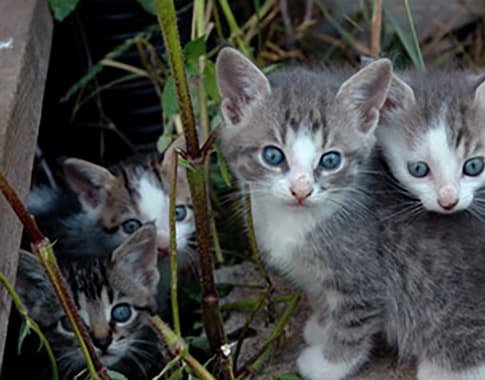
AnimalKind believes that all community cats equally deserve to live their best lives and receive quality care.
To learn more about community cats:
What is a Community Cat? | Learn More About Stray or Feral Cats Living Outdoors | Alley Cat Allies
A Closer Look at Community Cats | Stray Cats | TNR | ASPCA
Our Work | Alley Cat Allies | Protecting and Improving the Lives of Cats
Why Spay/Neuter Matters
Cats are extraordinarily efficient reproducers. A single unspayed female and her offspring can potentially produce dozens of kittens with sufficient food sources over just a few years. That rapid growth strains local resources, increases the number of kittens born into risky outdoor conditions, and drives up shelter intake which can often end up in euthanasia simply because there aren’t enough shelter spaces or foster homes.
Spay/neuter surgery breaks this cycle. It's the single most effective, humane tool we have for managing community cat populations.
How can I help community cats?
The impactful step you can take is to learn Trap, Neuter, Vaccinate, & Return (TNVR).
- Trap — Cats are humanely trapped using safe, non-harmful traps and transported to a vet or specialized spay/neuter clinic for sterilization.
- Neuter — They receive spay/neuter surgery and are "eartipped" (the top 3/8 inch of the left ear is clipped off), so they're recognizable as already fixed.
- Vaccinate – Most states require immunization with a rabies vaccine to increase public safety. Many clinics will include a feline distemper (FVCRP) vaccine as well.
- Return — Cats are returned to their outdoor home, where they continue living but can no longer reproduce.
Fixing and vaccinating free-roaming cats does the most to improve their lives as well as relieving caretakers and neighbors from the burdens of burgeoning colonies.
AnimalKind recommends taking the TNR Certification Workshop through Community Cats Central. There are also many reliable online sources for learning about TNVR.
Community Cat Programs Handbook | Best Friends Animal Society
communitycatscentral.com – Turning passion into action—for every cat, everywhere.
Bideawee | About TNR & Community Cats
You can also take further action by advocating for community cats with your neighbors and municipal leaders.
Creating Community Change | Alley Cat Allies
What do I do if I find kittens?
Do not snatch up kittens without first assessing their situation. In some cases, kittens are best left with their mother until they are old enough to take into rescue for adoption. Taking them too soon could potentially endanger their lives. Don’t be a kitten-knapper.
In all cases, find the mom and TNVR her at the appropriate time.
Found a Kitten Outdoors? Here's how to know what to do. — Kitten Lady